
Why Does My Dog Panic Every Time I Leave the House?
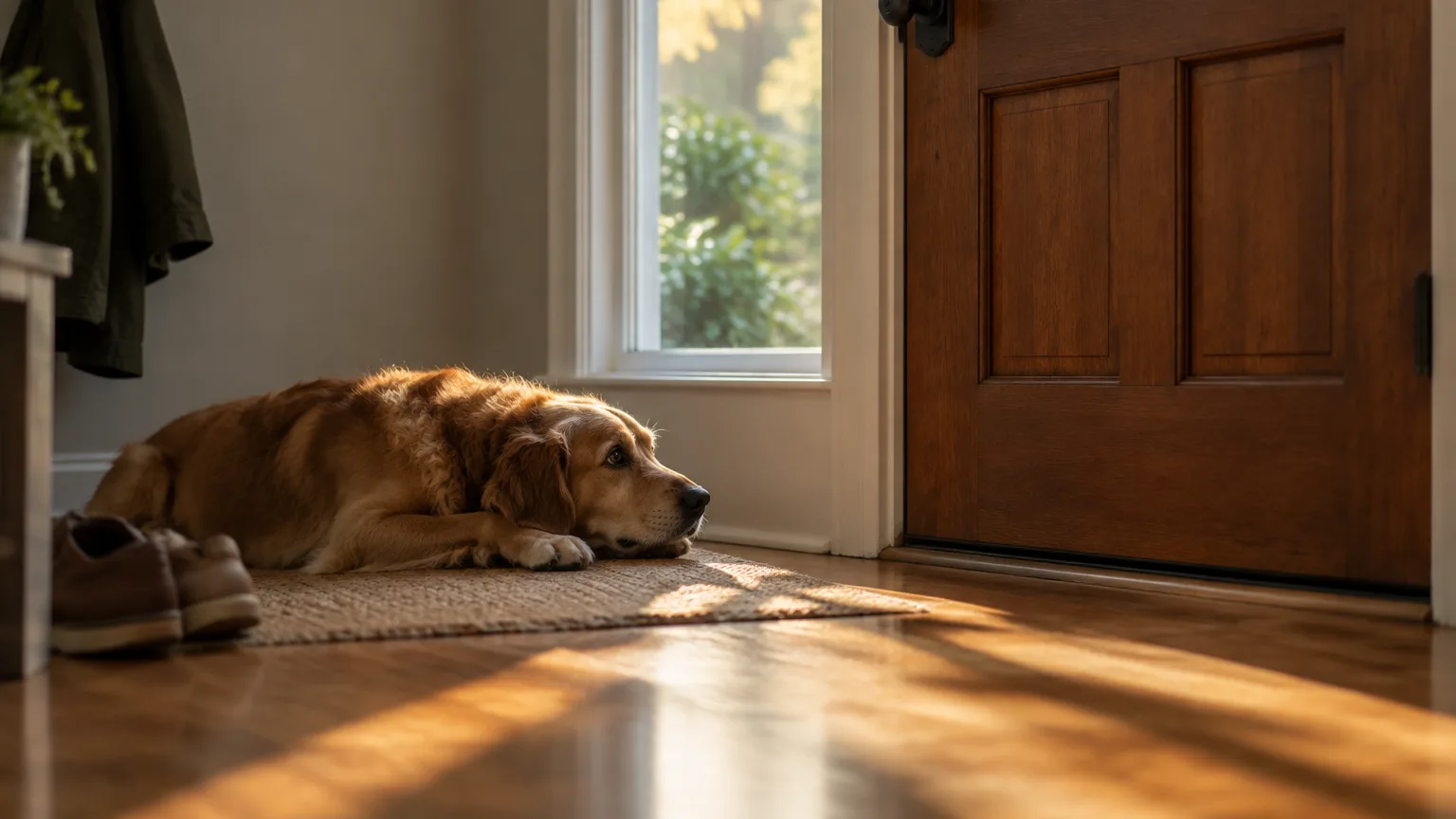
Separation anxiety is panic, not misbehavior, and it almost always starts before you leave. Your dog has learned to read the departure routine — keys, shoes, coat — and is already at full panic by the time the door shuts. That is why the fix begins with breaking those cues while you are still home, not with what you leave behind.
You pick up your keys. The dog is already at the door.
You put your shoes on and it starts to pace. By the time you are pulling out of the driveway, a neighbor could tell you exactly what is happening inside: howling, scratching, and a dog working itself into a state.
Then you come home to a chewed door frame and a dog that will not settle for an hour.
It is not boredom, and it is not bad behavior
Two things get blamed for this and neither is right.
The first is boredom. Boredom is real, but boredom damage looks different: it is slow, it is spread around the house, and it usually involves things that are fun to destroy. Anxiety damage clusters at the exits — the front door, the window frame, the gap under the door — because the dog is trying to follow you, not entertain itself.
The second is that the dog knows it is doing wrong. It does not. Dogs cannot connect a scolding at 6pm to something that happened at 9am, so the guilty look you get in the hallway is not guilt. It is a dog reading your body language and your tone and appeasing you. Punishing it adds a second thing to dread about your return.
What is actually happening is simpler and harder: your dog is having a panic attack, and it starts before you leave.
The part almost everyone misses
Watch the timeline instead of the damage.
Most owners assume the problem begins when the door closes. Point a phone camera at your hallway for one morning and you will usually see something else: the dog was already panting, pacing or shadowing you a full ten minutes earlier — from the moment you picked up your keys.
Dogs are extraordinary at spotting patterns. Yours has worked out the exact sequence that predicts you disappearing. Alarm, shower, particular pair of shoes, coat, keys, bag. It does not need all of them. Two or three in the usual order are enough.
So by the time you actually walk out, the dog is not starting to panic. It is already at the top of it.
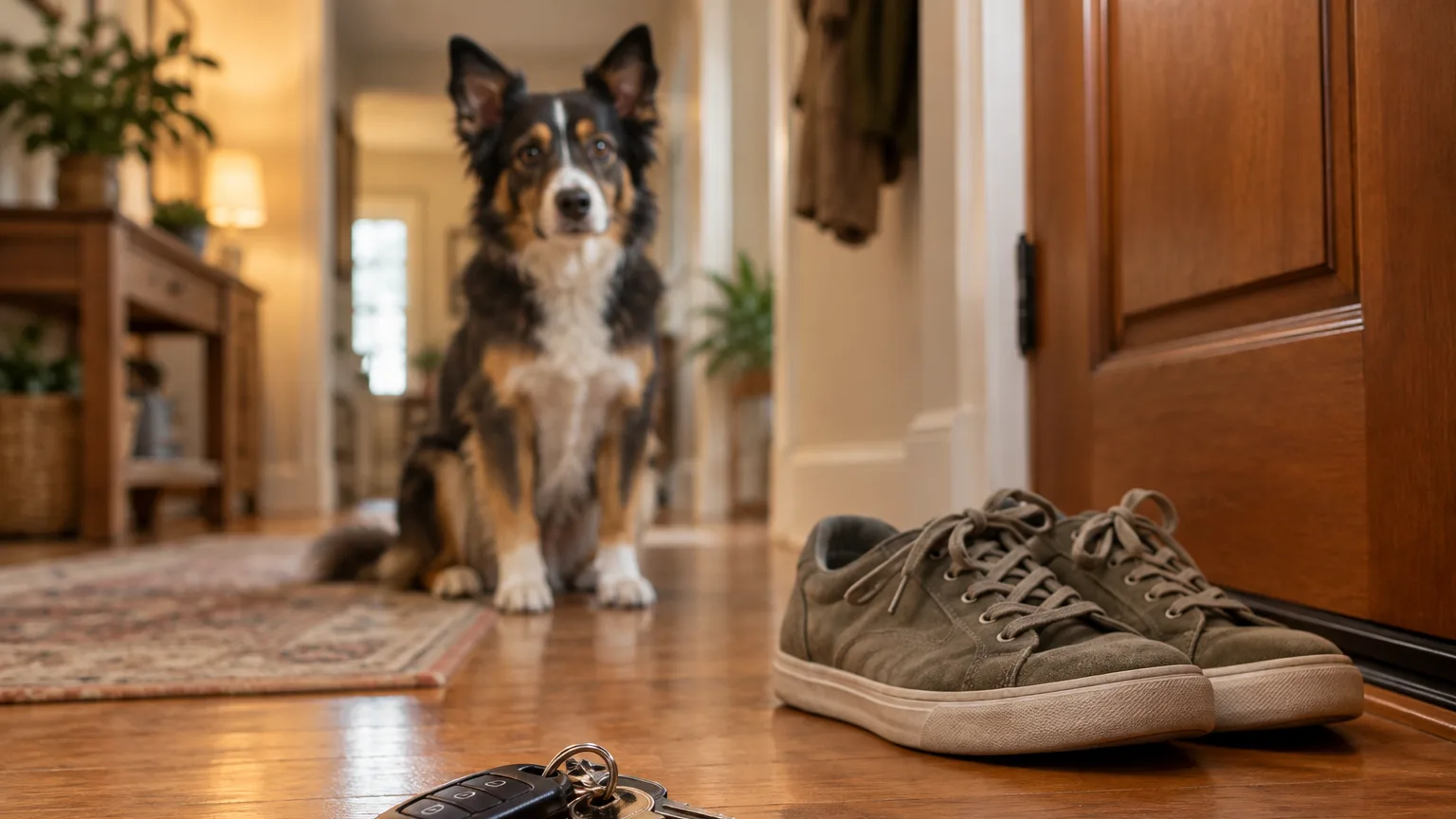
The panic starts here, several minutes before the door opens.
This is why the usual advice underdelivers. A stuffed chew toy at the door is being handed to a dog whose heart rate is already through the roof. You cannot feed your way out of a panic that started ten minutes ago.
Break the chain while you are still at home
The first real move costs you nothing and can be done tonight.
Take the cues apart, one at a time, without leaving.
Pick up your keys — then sit down and watch television. Put your shoes on — then make coffee. Put your coat on — then unload the dishwasher and hang it back up. Open the front door, stand there for five seconds, and close it again.
You are not trying to trick your dog. You are breaking a prediction. When keys have meant departure one hundred times out of one hundred, they carry enormous weight. When they have meant nothing at all thirty times this week, they stop being an alarm bell.
Do it casually and frequently. Ten repetitions scattered through an evening will do more than one long, deliberate training session.
Then leave — but for less time than the panic takes to start
Once the cues have lost some of their power, the departures themselves get rebuilt from zero.
Zero here is genuinely small. For some dogs the first useful departure is closing the door and opening it again after three seconds. Not three minutes. Three seconds.
The rule that matters: you come back before the dog gets upset, not after. Every time you return to a calm dog, you are teaching it that you come back. Every time you return to a dog that has already spiraled, you are proving that being left is as bad as it feared.
So you extend in small steps — three seconds, ten, thirty, a minute, two — and any time the dog struggles, you have gone too far and you drop back. Progress here is not linear and it is not fast. The people who take months are almost always the ones who went from two minutes to an hour on the first good day.
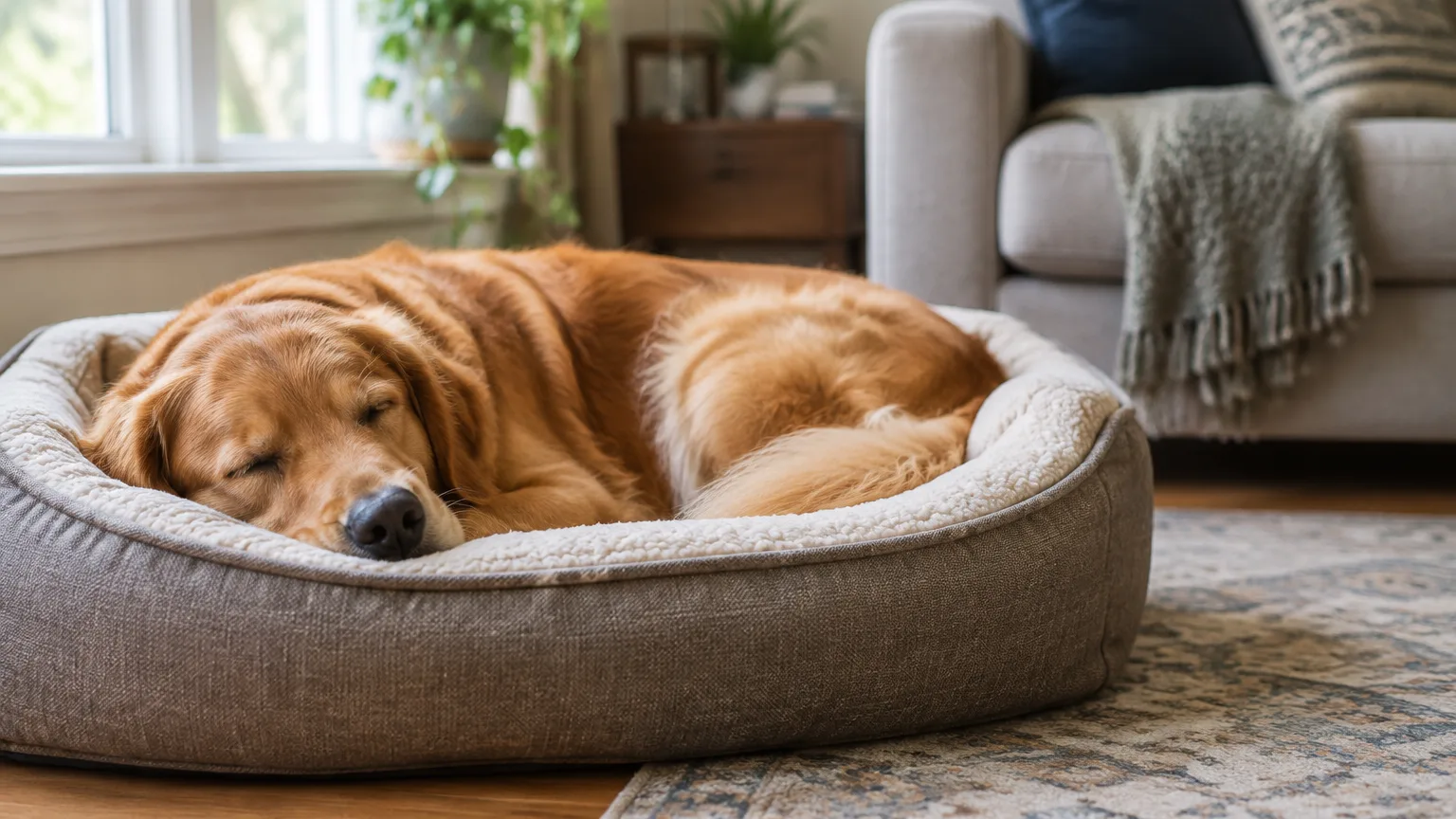
The goal is not a distracted dog. It is a dog that is genuinely switched off.
Three things that make it worse
Worth naming, because all three are well-meant.
The emotional goodbye. A long, sad farewell at the door tells the dog something significant is about to happen. Leave and arrive like it is nothing. Greet the dog a few minutes after you are in, once it has settled.
Getting a second dog. This is the most expensive wrong turn available. The panic is about your absence, not about solitude, so a companion usually does not touch it — and an anxious dog can teach the new one the same habit.
Crating a dog that is still panicking. A crate is a genuinely useful tool, but not for a dog in full panic. Dogs break teeth and tear nails trying to get out. Build the crate into somewhere it chooses to nap while you are at home, and use a safe empty room in the meantime.
What to change tonight
- Point your phone at the hallway for one morning departure. Watch when the panic actually begins — it will be earlier than you think.
- Pick up your keys five times this evening and go nowhere.
- Cut the goodbye. Out the door with no speech, and no big greeting until the dog has settled after you are back.

Calm arrivals and calm departures. The dog takes its reading from you.
Where this goes next
Breaking the cue chain and rebuilding short departures is the foundation, and for milder cases it is most of the work.
What takes longer is reading your own dog's early warning signs, knowing how fast to extend the time without going backwards, and handling the days when it regresses for no obvious reason. Those are judgement calls, and they are far easier to watch someone make than to read about.

Common questions
What is separation anxiety in dogs?
It is a panic response to being left alone, not disobedience. The dog is not choosing to howl or chew — it is in genuine distress, the same way a person having a panic attack is not choosing it. That is why scolding the dog when you get home never works.
How do I know if it is separation anxiety or just boredom?
Timing is the giveaway. Boredom damage happens slowly and spreads around the house. Anxiety damage is concentrated at exits — doors and window frames — and it starts in the first 15 to 30 minutes, usually with pacing, drooling and vocalizing. A phone camera pointed at the door will tell you within one session.
Will getting a second dog fix separation anxiety?
Usually not. The panic is about your absence specifically, not about being alone in general, so a companion dog rarely resolves it. It is also a large, expensive, permanent decision made in response to a temporary problem — and you can end up with two anxious dogs instead of one.
Should I crate a dog with separation anxiety?
Not while the dog is still panicking. A genuinely panicked dog can injure its mouth and paws trying to get out of a crate. Build the crate into a place it likes while you are at home first. Until then, a safe room with nothing to destroy is the better option.
How long does it take to fix separation anxiety?
It is measured in weeks, not days, and progress is not linear. Mild cases often settle in three to six weeks of consistent short departures. The mistake that costs most people months is jumping ahead the moment things look better.

Get the free book
Train or Regret? 5 Dog Owner Mistakes That Kill Dogs — a 20-minute read that shows you what to fix first. Sent straight to your inbox.
